May 22, 2026Last updated Oct 1, 2026By Naresh Ravish4 min read
ABC vs CO2 vs Foam: Which Fire Extinguisher Goes Where?
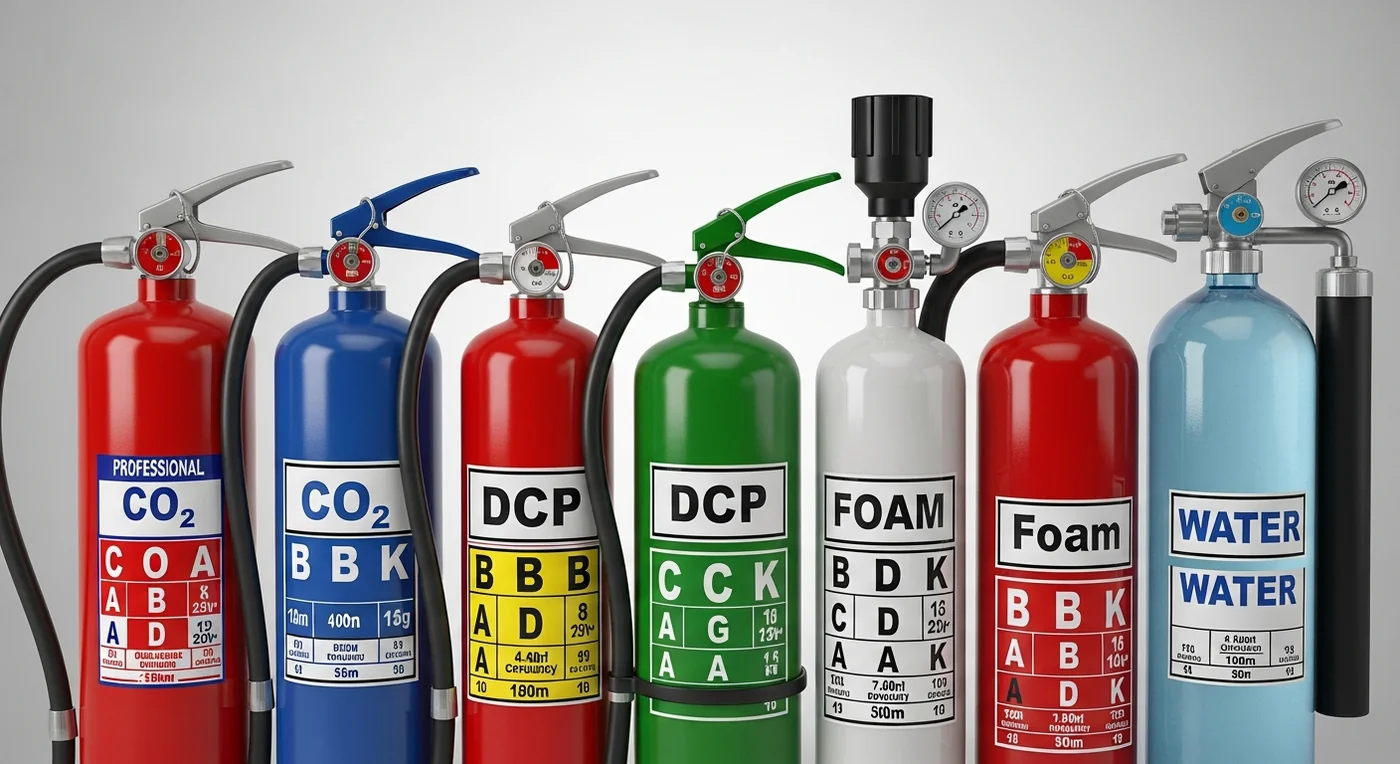
ABC powder, CO2 and foam extinguishers each fight different fires. A practical comparison — what each type is for, where it belongs in a shop, office, kitchen or factory, and the placement mistakes to avoid.
Fire classes first — the 30-second version
Extinguisher selection is really about fire classes. Class A is ordinary combustibles — wood, paper, cloth, plastics. Class B is flammable liquids — petrol, diesel, paint, thinner, oil. Class C in the Indian convention covers flammable gases like LPG, and electrical fires are treated as their own hazard requiring a non-conducting agent. Class D is metals, and Class K (or F) is cooking oil fires in kitchens.
No single extinguisher is best at everything. The right question is never "which extinguisher is best?" but "what is most likely to burn at this spot?" — the answer decides the type. That is why a proper site survey looks at each area of a premises separately instead of scattering identical cylinders everywhere.
ABC powder (monoammonium phosphate) is the workhorse of Indian premises because it covers Class A, B and C fires in one cylinder. It knocks down flames fast, works on burning solids as well as liquid spills, and is safe to use near most electrical equipment at typical voltages. For corridors, shop floors, godowns, schools, offices and general factory areas, ABC is usually the default choice.
Its trade-off is the powder itself. Discharge creates a fine cloud that reduces visibility and settles on everything — sensitive electronics, server racks, food preparation surfaces and precision machinery can suffer more damage from the powder than from a small fire. It also leaves a residue that needs proper clean-up. So ABC everywhere is a lazy design: it is right for most locations and wrong for a few important ones.
Best for: corridors, shops, godowns, offices, schools, general factory floors
Covers: Class A + B + C — the widest range in one cylinder
Avoid as the only option near: server rooms, panel rooms, labs, commercial kitchens
Common sizes: 4 kg and 6 kg wall-mounted; 25/50 kg trolley units for industrial areas
CO2 — clean agent for electrical and electronics
Carbon dioxide extinguishers smother a fire by displacing oxygen and leave zero residue. That makes CO2 the right choice where the fire risk is electrical or where powder damage is unacceptable: server and UPS rooms, electrical panels, DG rooms, laboratories, medical equipment areas and control rooms. The discharge horn gets extremely cold, and there is nothing to clean afterwards.
CO2's limits matter. It has little effect on deep-seated Class A fires — a smouldering pile of paper can re-ignite after the gas disperses. In open or windy areas the gas blows away quickly, reducing effectiveness. And because it displaces oxygen, discharging a large CO2 unit in a small unventilated room needs care. Standard practice pairs CO2 near the electrical risk with ABC nearby for everything else.
Best for: server rooms, electrical panels, DG sets, labs, control rooms
Leaves no residue — protects the equipment you are trying to save
Weak on smouldering solids; less effective outdoors
Common sizes: 2 kg, 3 kg, 4.5 kg; keep hands off the horn during discharge
Foam — liquids, fuel storage and spill risk
Mechanical foam (AFFF) extinguishers create a film that floats on burning liquid, sealing the surface, cutting off vapour and cooling the fuel. For Class B risks — fuel storage, paint shops, solvent stores, generator fuel tanks, oil-handling areas — foam is significantly better than powder at preventing re-ignition of a liquid fire, because the blanket keeps the surface sealed after the flames are out.
Foam also handles Class A well, but it is water-based: never for live electrical equipment, and unsuitable where the agent would be ruined by freezing or would damage stock. In practice, foam earns its place in specific liquid-risk zones of factories, workshops and fuel storage, rather than as a general-purpose unit.
Best for: paint/solvent stores, fuel handling, generator areas, oil-risk zones
Seals liquid surfaces — much better re-ignition control than powder on Class B
Never on live electrical fires; pair with CO2 where both risks exist
Common sizes: 9 litre portable; 50 litre trolley for larger risk areas
Putting it together — a placement cheat-sheet
A typical premises mixes all three. A school in Haryana might run ABC in corridors and classrooms wings, CO2 beside the electrical room and computer lab, and a K-type or foam unit at the kitchen/canteen. A factory pairs ABC across the shop floor, foam at the paint and fuel areas, CO2 at panels — plus hydrants and hose reels once the area and fire load cross thresholds.
Two final rules. First, placement beats quantity: an extinguisher within reach in 15 seconds is worth three stored in a locked room. Mount them on marked, visible, accessible points along movement routes. Second, an extinguisher is only real if it is serviced — pressure in the green, valid refill date, intact seal and a tag that proves it. If you are unsure what your premises needs, a free site survey settles it in one visit.
Frequently Asked Questions
Which is better, an ABC or a CO2 fire extinguisher?+
Neither is better everywhere. ABC powder covers Class A, B and C fires and is the usual default for corridors, shops, godowns and factory floors. CO2 leaves no residue and is the right choice for server rooms, electrical panels and labs.
Where should a foam fire extinguisher be used?+
Foam suits flammable-liquid risks such as paint and solvent stores, fuel handling and generator areas, because the foam blanket seals the liquid surface and helps prevent re-ignition. It must never be used on live electrical fires.
Can one type of extinguisher cover a whole building?+
Usually not. A typical premises mixes types: ABC in general areas, CO2 beside electrical rooms and computer labs, and foam or a kitchen-rated unit where liquids or cooking oil are the risk.
#Fire Extinguishers#Haryana
Need help with this at your own site?
Zed-King Institute of Fire And Safety has handled fire equipment, AMC, Fire NOC and training for factories, schools, hospitals and commercial buildings across Haryana since 2012. Free site survey, honest assessment — only what your building actually needs.