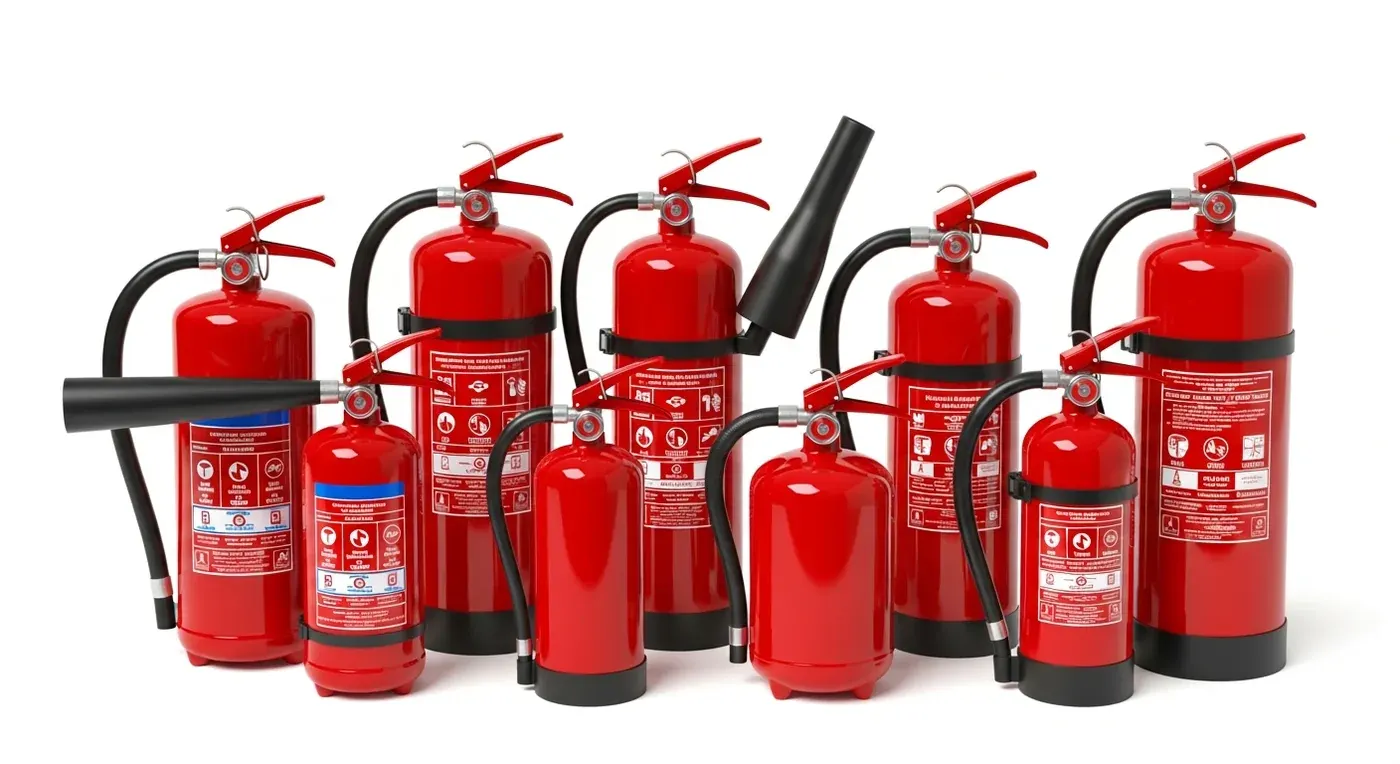
Fire classes explained (A, B, C, E)
Choosing a fire extinguisher starts with understanding what is likely to burn in your environment. Extinguishers are not universal tools. They are designed around fire classes, which describe the fuel involved and help determine which agent can control the fire safely. If the wrong extinguisher is used, the fire may continue spreading or the response may become more dangerous.
Class A fires involve ordinary combustible materials such as wood, paper, cloth, cardboard, rubber, and many plastics. These are common in homes, schools, offices, and storage areas. Class B fires involve flammable liquids such as petrol, diesel, paints, solvents, thinners, and some chemicals. Because these fuels can spread quickly over surfaces, they need an agent that suppresses combustion without splashing the burning liquid.
Class C fires generally involve flammable gases such as LPG, propane, or similar compressed combustible gases. In these situations, isolating the gas supply is often as important as controlling visible flame. Many sites also refer to Class E when talking about energized electrical equipment such as panels, UPS systems, appliances, wiring, motors, and server hardware. Even where local standards classify electrical fire differently, the practical site message remains the same: use an agent that is safe around live electrical hazards.
The purpose of classifying fires is not to make extinguisher buying complicated. It is to prevent dangerous assumptions. A building may contain more than one class of fire risk at the same time. That is why proper selection should be based on room-by-room hazard review instead of choosing one cylinder type for the entire property.
For a side-by-side comparison of the three most common types, see ABC vs CO2 vs foam extinguishers.
- Class A: wood, paper, cloth, cardboard, and similar ordinary combustibles.
- Class B: flammable liquids such as petrol, diesel, paints, and solvents.
- Class C: flammable gases such as LPG and other combustible compressed gases.
- Class E: energized electrical equipment such as panels, wiring, UPS systems, and appliances.
CO2 vs DCP - what is the difference?
CO2 and DCP or ABC powder extinguishers are both widely used, but they serve different priorities. Carbon dioxide extinguishers suppress fire by displacing oxygen around the flame. They are especially useful on energized electrical equipment and electronics because they do not leave residue. That makes them popular for server rooms, electrical panels, labs, control rooms, and office equipment clusters where cleanup damage matters.
ABC powder extinguishers are valued because they are versatile. They can handle multiple common fire risks, including ordinary combustibles, some flammable liquids, and electrical hazards depending on the rating. This makes them a practical choice for general areas such as shops, corridors, reception zones, vehicles, and mixed-use premises where one extinguisher may need to cover more than one likely scenario.
The drawback of CO2 is that it offers limited cooling on deep-seated Class A materials and can be less effective outdoors or in open, windy spaces. The drawback of powder is the heavy residue it leaves behind. That residue can reduce visibility, create cleanup issues, and damage sensitive electronics if discharged in equipment rooms. For this reason, many well-planned sites use both types in different places rather than trying to force one solution everywhere.
Operational handling is also different. CO2 horns become extremely cold during discharge, and the extinguishing time may be relatively short. Powder extinguishers offer broader use, but staff still need training to approach safely and keep an exit route behind them. The right choice depends on the actual hazard, not just familiarity or price.
- CO2: clean discharge, useful for electrical panels, server rooms, control rooms, and electronics-heavy spaces.
- ABC or DCP: broad-use option for general areas, corridors, shops, storage zones, and vehicles.
- CO2 leaves no residue but offers limited cooling on deep Class A materials.
- DCP covers multiple hazards but can create heavy cleanup and contamination in sensitive areas.
How many extinguishers do you need?
The correct number of extinguishers depends on floor area, travel distance, occupancy, local code, and the type of hazards present. There is no single quantity that fits every building. A small office, fuel storage room, school floor, and warehouse bay cannot be planned the same way. The basic principle is that people should be able to reach an appropriate extinguisher quickly without crossing a high-risk zone or travelling too far.
The best way to estimate quantity is to divide the site into practical risk zones. Reception, office space, pantry, electrical room, server room, loading area, archive room, and parking space may each require different coverage. Large open floors often need multiple extinguishers of the same type because one incident should not leave the entire floor without nearby access to equipment.
Visibility matters just as much as quantity. An extinguisher is not truly available if it is hidden behind furniture, mounted inside a locked area, blocked by inventory, or installed where visitors will never notice it. Good coverage planning therefore includes mounting height, wall signage, approach path, and whether the unit remains visible after interior changes.
Wherever possible, create a layout map showing extinguisher type and location. This supports maintenance, training, and audits, and it helps ensure that future interior work does not accidentally remove or isolate key protection points.
- Plan extinguisher quantity by risk zone, travel distance, floor area, and code requirements.
- Place units near exits, circulation paths, and decision points instead of hidden corners.
- Avoid locating critical extinguishers behind locked doors or temporary storage.
- Use clear signage and proper mounting so people can identify the nearest unit quickly.
Quick checklist before buying
Buying the right extinguisher is not only about the extinguishing agent. Product quality, certification, refill support, maintenance availability, and long-term serviceability matter just as much. A low-cost cylinder from an unreliable supplier may satisfy a short-term purchase request but fail when you actually need it.
Always verify relevant certification marks, the manufacturing date, condition of hose and nozzle assemblies, bracket quality, seal integrity, and the clarity of operating instructions on the label. Ask the supplier whether they also provide installation guidance, safety signage, annual maintenance, hydrostatic testing support where required, and refill service. For sites with many extinguishers, ongoing support is often more valuable than a small upfront saving.
Capacity must also fit the environment. A compact extinguisher may be enough for a small vehicle or cabin, but larger spaces or higher-risk areas may need bigger units or multiple points. Usability matters too. Heavier units can provide longer discharge, yet some occupants may find them harder to handle quickly under stress.
The strongest purchasing decision is one made jointly by safety, operations, and maintenance teams. That way the extinguisher is not only technically suitable, but also realistically placed, supported, and maintained after installation.
- Verify BIS or ISI marking, manufacturing date, label clarity, and overall cylinder condition.
- Choose suppliers who can support refill, AMC, periodic inspection, and documentation after purchase.
- Select the right capacity for the hazard and the people expected to use the extinguisher.
- Include brackets, signage, and installation planning in the buying decision, not after it.
Common selection mistakes to avoid
One common mistake is buying one extinguisher type for the entire site simply to simplify procurement. This usually leaves high-risk areas underprotected or sensitive areas exposed to unnecessary contamination. Another mistake is copying a neighboring building without checking whether the hazards are actually similar.
A second major mistake is ignoring maintenance after installation. Even the best extinguisher becomes unreliable if service dates are missed, gauges are not checked, seals are broken, or corrosion goes unnoticed. Buyers should build a maintenance calendar immediately instead of treating upkeep as a later problem.
The final mistake is assuming extinguishers alone create safety. They are only one layer of fire protection. Detection, alarms, evacuation planning, signage, and training must support them. When extinguisher selection, placement, and maintenance are handled thoughtfully, these units become a powerful first-response tool instead of a decorative compliance item.
Where different extinguisher types fit best
In practical site planning, extinguisher choice should follow the actual use of each area. Reception spaces, corridors, classrooms, shops, and ordinary office floors usually benefit from broad-use ABC coverage because the risks are mixed and the likely first responder may be a non-technical occupant. Electrical rooms, server cabinets, UPS areas, and control rooms usually need CO2 nearby because residue-free discharge can prevent secondary damage to equipment. Pantry or cooking-related areas may require specialized kitchen suppression depending on the hazard, while parking zones or vehicle fleets may need compact units placed for quick access.
This area-based approach prevents overdependence on one extinguisher style. It also improves training because staff can understand why a certain cylinder is placed in a certain location. When teams know that the red powder extinguisher in the corridor is for general response and the CO2 unit near the panel is for electrical equipment, they make faster and safer decisions. Good extinguisher planning is therefore not just about product selection. It is about matching risk, placement, user ability, and maintenance into one simple, understandable safety layout.
Need help with this at your own site?
Zed-King Institute of Fire And Safety has handled fire equipment, AMC, Fire NOC and training for factories, schools, hospitals and commercial buildings across Haryana since 2012. Free site survey, honest assessment — only what your building actually needs.