Why this question keeps coming up in Hansi
Hansi has grown from a sub-division town into a district of its own, and the units along the Hisar–Delhi highway and around the town have grown with it — cotton and agro-processing, small fabrication shops, godowns and cold stores. Many of these sites started small with a few extinguishers on the wall. As the sheds get bigger, the stock gets heavier and the Fire NOC comes up for renewal, owners start hearing two words from the fire department and from their insurer: hydrant and sprinkler.
Extinguishers are meant for the first minute of a small fire. A hydrant system is what lets trained people fight a fire that has already spread, with a large, pressurised water supply that does not depend on a fire tender arriving in time. Sprinklers go one step further: they open on their own over the fire and control it before anyone has even reached the spot. For a building full of cotton bales, packaging or finished goods, that difference decides whether you lose one bay or the whole shed.
This guide explains what these systems actually consist of, how to tell whether your building needs them, and what a sensible installation and hand-over looks like — so you can talk to contractors and the fire department with a clear picture.
Does your building need a hydrant system, sprinklers, or both?
There is no single answer for every factory. The requirement depends on the type of occupancy, the built-up area, the height of the building and how much combustible material is stored inside. The National Building Code of India (Part 4, Fire and Life Safety) sets out these requirements, and the fire department applies them when it checks your Fire NOC application. A small workshop may only need extinguishers and hose reels; a large godown or a multi-storey unit will usually need a full hydrant system, and high-hazard storage often needs sprinklers as well.
The honest way to find out is a site survey against your actual drawings, not a guess based on what a neighbour installed. Two sheds of the same size can need very different systems if one stores steel and the other stores cotton. A good consultant will show you which clause applies to your building and why, rather than simply quoting the biggest possible system.
- Type of occupancy (manufacturing, storage, mixed use)
- Covered area of each block and the total site
- Building height and number of floors
- What is stored inside and how it is stacked
What a hydrant system is actually made of
A hydrant system is not just the red outlets you see on the wall. It starts with a dedicated fire water storage tank, kept only for firefighting so the water is always there when needed. From the tank, a pump room feeds the network: usually a main electric pump, a diesel-driven standby pump that keeps working during a power cut, and a small jockey pump that keeps the pipes pressurised and makes up minor leaks.
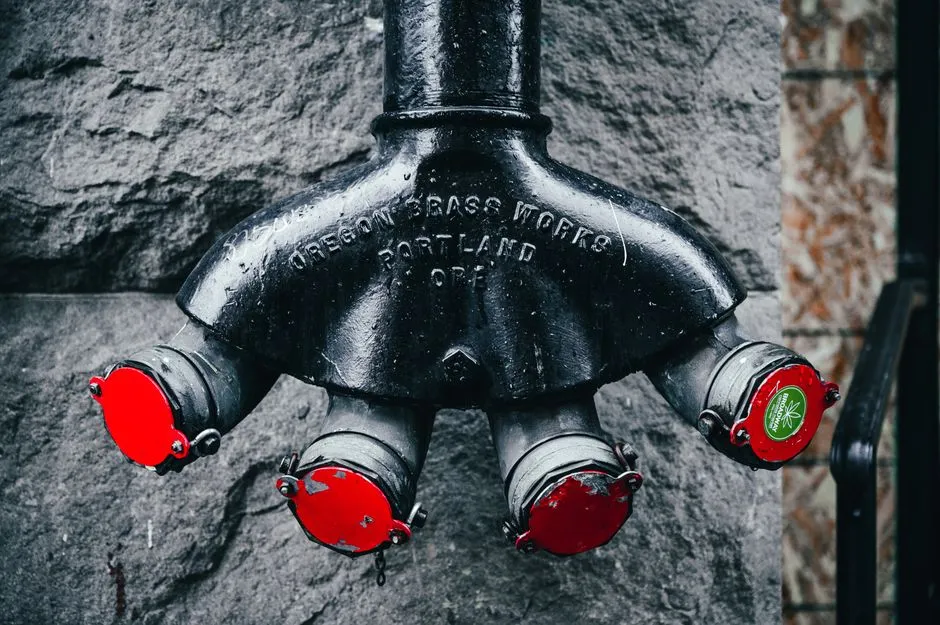
The pumps push water into a ring main — a loop of pipe around the building, either underground or above ground — so every outlet can be fed from two directions. Along this loop sit yard hydrants outside the building and internal hydrants with hose reels inside. A fire brigade inlet lets the fire tender pump extra water into the system if needed. Valves at key points allow one section to be isolated for repair without shutting down the whole network.
Each part matters. A system with a good pipe network but no reliable standby pump, or a tank that is also used for daily washing, can fail at exactly the moment it is needed.
- Dedicated fire water storage tank
- Pump room: main electric pump, diesel standby pump, jockey pump
- Ring main with isolation valves
- Yard hydrants, internal hydrants and hose reels
- Fire brigade inlet connection
Where sprinklers fit in
A sprinkler system uses the same kind of pressurised water supply but delivers it automatically. Each sprinkler head has a heat-sensitive element; when the air around it gets hot enough, only that head opens and sprays water over the fire. The heads that are not near the fire stay closed, so the water damage is limited to the area that is actually burning.
Sprinklers are most valuable where fire can grow fast and where nobody is present at night — storage racks, packing areas, raw-material godowns. The layout has to match how the space is really used: the height of stacks, the gap between the top of the stock and the sprinkler heads, and obstructions like beams and ducts all affect coverage. This is why a sprinkler design should be done with hydraulic calculations for your building, not copied from another site.
How a proper installation and hand-over should go
A well-run project follows a clear order. It starts with a site survey and a design based on your drawings, followed by the Fire NOC documentation that shows the fire department what will be installed. Installation then covers the tank connections, pump room, ring main, hydrants and sprinklers, done in stages so your production is disturbed as little as possible.
Testing is the step owners should never let a contractor rush. The pipework should be pressure-tested and held while the readings are watched for any drop. The pumps should be run and shown to start automatically — including the diesel pump with the electricity switched off. Hydrants should be opened to show that water reaches the far end of the network at working pressure. You should receive the test records, the as-built drawings and a short training for your own staff on how to operate the system.
Keep these papers safe. The fire department will ask for them during inspection and renewal, and your insurer may ask for them after any claim.
- Site survey and design based on your drawings
- Fire NOC documentation before work starts
- Staged installation to limit production downtime
- Pressure test, pump start test and flow test at hand-over
- Test records, as-built drawings and staff training
Keeping it working after the contractor leaves
Most hydrant systems that fail in a real fire were installed correctly but not looked after. Diesel pumps with flat batteries, valves left closed after a repair, hose reels with cracked hoses and tanks quietly used for other work are all common findings during inspections. A simple routine — weekly pump runs, monthly visual checks and a proper annual service — prevents almost all of them.
An annual maintenance contract puts that routine on a fixed calendar and gives you a signed service report after every visit, which is exactly what inspections and Fire NOC renewals ask to see.
Getting started in Hansi
If your Hansi unit is expanding, storing more material or has a Fire NOC renewal coming up, start with a survey rather than a quotation. Zed-King Institute of Fire And Safety, based in Kaithal, designs, installs and maintains hydrant and sprinkler systems for factories and godowns across Haryana, and offers a free site visit to tell you what your building actually needs — and what it does not.
Need help with this at your own site?
Zed-King Institute of Fire And Safety has handled fire equipment, AMC, Fire NOC and training for factories, schools, hospitals and commercial buildings across Haryana since 2012. Free site survey, honest assessment — only what your building actually needs.