Jul 22, 2026Last updated Oct 1, 2026By Naresh Ravish7 min read
Fire Safety Checklist for Transporting Hazardous Materials on Haryana Roads
Practical steps to load, maintain, train, plan routes and respond to emergencies when moving flammable goods on Haryana roads.
When a highway collision becomes a fire
Imagine a heavy dumper loaded with diesel-filled drums colliding with a trailer carrying LPG cylinders on a dusty stretch near the Punjab-Haryana border. The impact ruptures several drums and starts a fire that quickly engulfs both vehicles. First responders struggle to contain the flames because the cargo is unsecured and the driver has no fire extinguisher on board. The scenario shows a chain of avoidable mistakes: poor load restraint, inadequate vehicle inspection, and no clear emergency protocol. For businesses that move flammable or combustible goods across Haryana, the lesson is stark and actionable.
A minor collision can become a full-scale disaster when hazardous cargo is involved. Smoke can spread for kilometres, traffic on the highway stops, and nearby villages may have to be evacuated. Fire crews have to keep the flames away from the LPG cylinders, because a heated cylinder can explode. A systematic checklist is what stops a fire like this before it starts.
While a collision may be unavoidable, the fire that follows is not. By looking at each phase (loading, vehicle condition, driver competence, route selection, and emergency readiness) we can build safeguards. The following sections break down each element into concrete actions.
Secure loading practices for flammable drums and cylinders
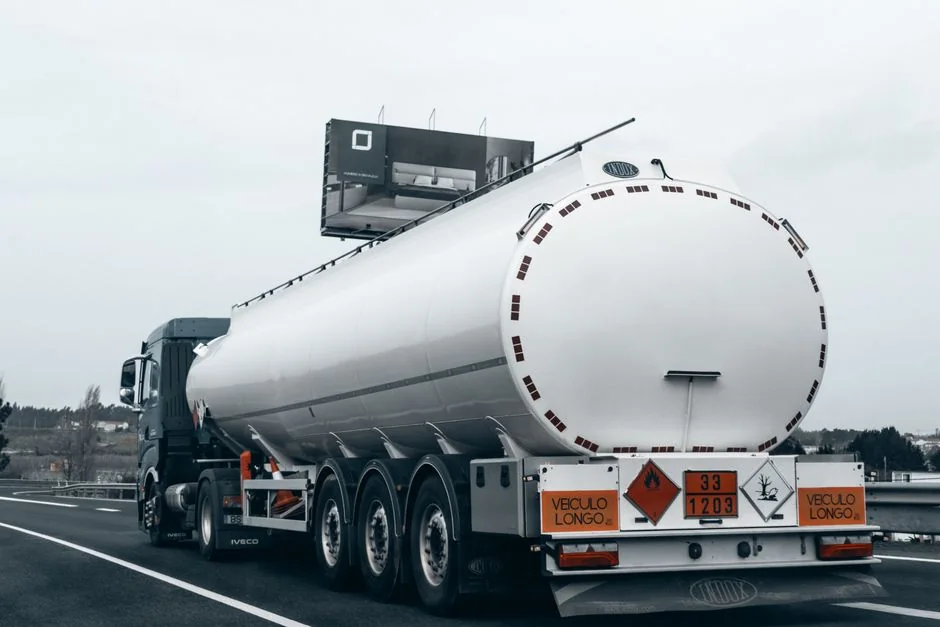
The first line of defence is a disciplined loading routine. Every drum or cylinder must be inspected for dents, rust or faulty valves before it touches the chassis. Workers should use a calibrated torque wrench to tighten valve caps to the manufacturer’s recommendation, and any damaged container must be segregated for separate handling. Once cleared, the cargo is placed on a flat-rated pallet that matches the vehicle’s load-bearing capacity, then chained or strapped with high-tensile steel webbing that passes through reinforced anchor points on the truck frame.
When stacking multiple layers, the centre of gravity must stay low and centred. A simple visual check—drawing an imaginary line from the front axle to the rear axle—helps ensure the load does not shift during braking or cornering. In addition, a fire-resistant barrier, such as a steel sheet or fire-retardant blanket, should be positioned between the cargo and the vehicle cabin to protect the driver in case of a flash fire. Labels indicating the hazard class (flammable liquid, combustible gas, etc.) must be clearly visible from both sides of the vehicle.
Finally, a pre-departure checklist signed by the loading supervisor confirms that every step was followed. This document becomes part of the transport record and can be shown to police or fire officials during routine checks. The checklist includes items such as “no loose drums on the floor”, “all straps tensioned”, and “fire-extinguishing equipment mounted and accessible”. A disciplined approach at the loading dock eliminates the most common cause of cargo-related fires.
Inspect each container for damage before loading
Use calibrated torque for valve caps
Secure with steel webbing through reinforced anchor points
Maintain low, centred centre of gravity
Place fire-resistant barrier between cargo and cabin
Complete signed pre-departure loading checklist
Vehicle maintenance that keeps fire risks at bay
A well-maintained vehicle is less likely to spark a fire during normal operation. Regular engine oil changes, coolant checks and fuel-line inspections remove the chances of leaks that could meet a hot surface. The brake system deserves particular attention; overheated brakes can ignite nearby combustible material, especially after long spells of heavy braking.
Electrical wiring must be inspected for frayed insulation or loose connections. A faulty alternator or a shorted wire can produce sparks that ignite vapours escaping from a poorly sealed drum. During routine servicing, the mechanic should also verify that the exhaust system is intact, with no cracks that could allow hot gases to contact the cargo area. Any modifications to the chassis—such as added racks for extra drums—must be approved by a certified fire-safety engineer.
Fire-safety service providers can offer a dedicated vehicle-inspection service that checks these critical points and gives a written inspection report. Their engineers use portable gas detectors to sniff out hidden leaks and confirm that the fire-extinguishing equipment on board is in working order. Engaging such a service before the first trip of each season adds a layer of assurance that the vehicle itself will not become the ignition source.
Schedule regular engine oil and fuel-line inspections
Check brakes for overheating after heavy use
Inspect electrical wiring for insulation damage
Verify exhaust system integrity
Get the vehicle and its extinguishers checked by a qualified provider
Driver training and behavioural safeguards on the road
Drivers handling hazardous cargo must understand both the technical and behavioural aspects of fire safety. A certified training programme covers topics such as reading safety data sheets, recognizing early signs of a leak, and operating the on-board fire-extinguisher correctly. Role-playing drills simulate a sudden loss of pressure in a gas cylinder, teaching the driver to stop, isolate the source and alert emergency services without panic.
Behavioural habits also matter. Drivers should avoid abrupt acceleration or harsh braking, which can jostle unsecured containers. When navigating tight bends, especially near market areas in Hisar or Jind, reducing speed gives the load time to settle and prevents the straps from loosening. A simple rule—no overtaking in rain-slick conditions when carrying flammable liquids—reduces the chance of a side-impact that could breach a drum.
Periodic refresher courses keep the knowledge fresh, and a logbook documenting each training session becomes part of the company’s safety dossier. When a driver completes the programme, the certificate can be displayed in the cab, signalling to inspectors that the operator is competent. This systematic approach transforms the driver from a potential weak link into an active fire-safety asset.
Practice leak-identification and extinguisher use drills
Maintain a driver logbook with training records
Adopt smooth driving habits to minimise load movement
Schedule annual refresher training
Route planning that avoids high-risk zones and prepares for emergencies
Choosing the right route can dramatically cut fire-risk exposure. Planners should consult Haryana’s road-condition maps to bypass congested market streets in Panipat during peak hours, where accidental spills are more likely. Where possible, routes that keep the vehicle on well-maintained national highways reduce the chance of pothole-induced jolts that could damage containers.
Every trip must include a pre-planned emergency stop point—ideally a fire-station or a fuel-pump with a fire-extinguishing system. The driver should carry a printed map highlighting the nearest safe zones, along with contact numbers for local fire-brigade units in Kaithal, Rohtak and Kurukshetra. A mobile app that shares real-time GPS location with the company’s control room allows supervisors to dispatch help within minutes if an alarm sounds.
In addition to static stops, a dynamic risk-assessment checklist is useful at each checkpoint. The driver confirms that the fire-extinguisher pressure gauge reads within the green zone, that the cargo straps are still tight, and that no visible leaks are present. If any item fails, the vehicle must pull over at the nearest safe location for a quick inspection before proceeding. This layered planning transforms a simple point-to-point journey into a managed safety operation.
Avoid congested market streets during peak hours
Identify nearest fire-station or equipped fuel-pump as emergency stop
Carry printed map with emergency contact numbers
Use GPS sharing with control room for rapid assistance
Perform checkpoint risk-assessment before continuing
Emergency response actions and post-incident follow-up
If a fire does break out, the driver’s first move is to activate the vehicle’s built-in alarm and pull the emergency shut-off valve for any liquid cargo. This isolates the source of fuel and reduces the fire’s intensity. The driver then deploys the appropriate fire-extinguisher—foam for flammable liquids, CO2 for electrical fires, or a dry-chemical agent for gas cylinders—while maintaining a safe distance.
Simultaneously, the driver contacts the nearest fire-brigade using the pre-saved number, providing precise coordinates, the type of material involved and the current status of the fire. While waiting for responders, the driver should evacuate the cab, move any nearby personnel to a safe distance, and, if possible, use a fire-resistant blanket to smother small flames. After the incident, a thorough incident-report is filed, documenting cause, response time, equipment performance and any injuries.
A post-incident review with the company’s safety officer helps close the loop. Recommendations may include replacing worn straps, revising the loading checklist, or updating driver training modules. Fire-safety service providers can conduct a site survey to assess the effectiveness of emergency equipment and suggest improvements, ensuring that the next trip starts with a stronger safety net.
Activate vehicle alarm and shut-off valve immediately
Use the correct extinguisher type for the material
Call fire-brigade with exact location and cargo details
Evacuate cab and keep bystanders at a safe distance
Complete incident report and conduct post-incident review
Frequently Asked Questions
How should flammable drums and cylinders be loaded?+
Inspect every container for damage before loading, tighten valve caps, secure the load firmly to proper anchor points and keep the weight low and centred. Complete a signed loading checklist before departure.
What should a driver do if a fire breaks out?+
Stop, isolate the fuel source if it is safe, use the correct extinguisher from a safe distance, call the fire brigade with the exact location and cargo details, and keep bystanders away.
Why does vehicle maintenance matter for fire safety?+
Leaking fuel lines, overheated brakes, frayed wiring and a damaged exhaust can all ignite cargo vapours, so these points need regular inspection.
#Safety Checklists#Haryana
Need help with this at your own site?
Zed-King Institute of Fire And Safety has handled fire equipment, AMC, Fire NOC and training for factories, schools, hospitals and commercial buildings across Haryana since 2012. Free site survey, honest assessment — only what your building actually needs.